







There’s something quietly thrilling about walking into a room that refuses to be just one thing. A velvet sofa next to a raw-edged wooden table. Moroccan tiles meeting mid-century pendant lights. A gallery wall that tells ten different stories at once. If you’ve ever felt drawn to that kind of controlled chaos—where beauty lives in the unexpected—you already understand the soul of modern eclectic interior design.
This isn’t a style born from indecision. Far from it. Modern eclectic interior design is one of the most intentional, personality-driven approaches to decorating a home that exists today. It asks you to look beyond trends, dig into what genuinely moves you, and find ways to make very different things feel like they belong together.
In this guide, we’re going deep—into the history, the principles, the practical how-tos, and the small details that separate a beautifully layered eclectic space from a cluttered one. Whether you’re starting from scratch or trying to breathe new life into rooms that feel a little too safe, this is the guide you’ve been looking for.
What Is Modern Eclectic Interior Design, Really?
Before anything else, let’s put a clear definition on the table—because “eclectic” gets thrown around loosely in the design world, and not always accurately.
Eclectic interior design is the art of combining elements from multiple design styles, time periods, and cultural aesthetics into a space that feels cohesive and intentional rather than scattered. The “modern” qualifier is important: it grounds the approach in a contemporary sensibility, ensuring that whatever mix of influences you bring in, the result reads as current rather than dated.
Think of it less like decorating and more like curating. A skilled eclectic designer—or a thoughtful homeowner—acts the way an art director does: selecting pieces for the feeling they create together, not just the statement each makes individually.
The common misconception is that eclectic means “anything goes.” It doesn’t. True modern eclectic interior design has rules—they’re just more fluid than those of, say, Scandinavian minimalism or traditional farmhouse. The rules live in proportion, color harmony, texture balance, and that hard-to-define thing called visual flow.
The Difference Between Eclectic and Just “Mixed Up”
A room can have furniture from four different decades, two different continents, and three different color families and still feel completely intentional. It can also have pieces from the same store, bought in the same week, and feel completely incoherent. The difference isn’t the variety of sources—it’s the presence or absence of a governing visual logic.
That logic usually comes down to a few things: a consistent color story, a repeated material or texture, a shared sense of scale, or an emotional throughline. When those anchors are in place, almost any combination of styles can work. When they’re missing, even matching furniture sets can feel cold and unresolved.
The Roots of the Eclectic Style: Where It Comes From
Modern eclectic interior design didn’t spring up in the Instagram era, though social media has certainly given it a massive platform. Its roots go back much further.
In the 19th century, wealthy European households began collecting objects from their travels—Japanese ceramics alongside French armchairs, Indian textiles draped over English writing desks. This “collector’s aesthetic” was partly about status, but it also reflected a genuine curiosity about the wider world. Those rooms had a richness that more uniform spaces simply couldn’t match.
By the mid-20th century, designers like Dorothy Draper and Tony Duquette were pushing the idea of fearless mixing into the mainstream. Their rooms were bold, layered, and deeply personal—entirely at odds with the period’s prevailing taste for matched sets and coordinated suites.
How Mid-Century Modern Became the Eclectic Designer’s Favorite Anchor
Ask any interior designer today about their most-used starting point for an eclectic space, and a significant number will say mid-century modern. There’s a reason for this. The clean lines, organic forms, and restrained palette of eclectic mid century modern interior design create a kind of visual grammar that plays well with almost everything else.
A mid-century sofa—say, a low-slung walnut-legged piece in warm mustard—acts like a grounding note in a room. It has enough presence to hold its own but enough neutrality to let other, more expressive pieces shine around it. Pair it with a maximalist kilim rug, an industrial pendant light, and a cluster of vintage ceramics, and suddenly you have a room that’s simultaneously rooted and surprising.
This is why eclectic mid century modern interior design has become such a beloved framework: it gives you the bones of restraint while still leaving enormous room for personality.
Core Principles of Modern Eclectic Interior Design Style
Understanding the modern eclectic interior design style at a principles level is what separates beautiful results from beautiful accidents. Here are the foundations that every successful eclectic space shares.
1. Establish a Unifying Color Story
Color is the fastest way to create cohesion across disparate elements. In eclectic spaces, this doesn’t mean using only one or two colors—it means choosing a palette of four to six hues and committing to them across the room, even as you mix periods and styles freely.
Warm neutrals (think terracotta, warm white, aged brass) are particularly effective as a base because they read as inviting and timeless, giving more unusual pieces a soft landing. Against that kind of ground, even the most unexpected element—an Art Deco mirror, a brutalist concrete planter—finds its footing.
Cool palettes work beautifully too, especially when you’re anchoring the room in modern eclectic interior design that skews more contemporary. Deep slate blues, sage greens, and off-whites can hold a very wide range of objects without the space feeling chaotic.
2. Balance High and Low
One of the most enduring pieces of advice in eclectic design is to mix price points as freely as you mix styles. A room that’s all heirlooms and investment pieces reads as a showroom. A room that’s all fast-furniture reads as provisional. The magic lives in the contrast.
A $3,000 bespoke armchair gains character when it’s placed next to a $40 thrift-store side table that’s been painted the right color. A hand-knotted Turkish rug makes a flat-pack bookshelf look more considered. This is less about budget and more about the visual tension between refined and raw, precious and humble—a tension that gives eclectic rooms their particular aliveness.
3. Vary Texture and Material Constantly
In a room where everything is the same material—all chrome, all linen, all lacquered wood—the eye has nowhere interesting to go. Eclectic spaces succeed in large part because they offer constant textural variety: rough linen beside smooth leather, matte terracotta beside polished brass, nubby wool beside polished concrete.
This isn’t about cramming in as many materials as possible. It’s about making sure that at every visual resting point in the room, there’s something tactilely interesting happening. Surfaces that invite touch make spaces feel lived-in and warm rather than designed and untouchable.
4. Respect Scale and Proportion
The one place where eclectic design demands discipline is scale. You can mix any style with any other style, but if the proportions are off—a tiny accent chair marooned in a cavernous room, or an oversized sofa crammed into a small space—the room will never quite settle.
As a rule, anchor each major zone of a room with at least one piece that commands the space in scale: a large sofa, a generous dining table, a statement bed. Everything else can be mixed freely, but that anchor needs to earn its place through size.
How to Build an Eclectic Room from Scratch
Theory is one thing. Actually standing in an empty room and making decisions is another. Here’s a practical sequence that consistently produces beautiful results.
Start With One Statement Piece You Love Unreservedly
Don’t start with the sofa or the rug. Start with the piece that makes you feel something—the piece you’d move into any house because it goes with you, not with a particular room. This might be a painting, a vintage lamp, a handmade ceramic, or an unusual chair. Whatever it is, that piece becomes your compass.
Every other decision in the room should have some connection back to that piece—whether it’s a color it contains, a material it shares, a period it references, or an emotional register it establishes. This is how eclectic rooms avoid feeling random: they orbit a center of gravity.
Layer in Your Major Furniture
Once your anchor piece is chosen, bring in the larger furniture items—sofa, bed frame, dining table—with an eye toward proportion and color harmony. In a modern eclectic interior design style approach, these pieces don’t all need to match. In fact, they shouldn’t. But they should feel like they’re having a conversation rather than talking past each other.
A good test: squint at the room. If the arrangement of major pieces still makes visual sense when the details blur out, the bones are working. If it looks like furniture was simply deposited at random, something needs to shift.
Build Texture and Personality Through Smaller Pieces
This is where the real fun begins. Rugs, cushions, throws, art, plants, ceramics, books—these are the layers that give eclectic rooms their depth. Add them slowly, stepping back often. The goal is richness, not saturation. Every addition should either strengthen the color story, add a missing texture, or introduce a piece of personal narrative.
One reliable technique: group objects in odd numbers (threes and fives tend to look more natural than pairs or fours) and vary height within each grouping. A tall vase beside a medium candle holder beside a small bowl creates visual movement in a way that three objects of the same height never will.
Eclectic Mid Century Modern Interior Design: A Closer Look
Of all the frameworks for building an eclectic space, the eclectic mid century modern interior design approach is perhaps the most widely beloved—and for good reason. Mid-century design has a clarity and confidence that makes it an almost universally stable foundation.
The characteristic elements—tapered legs, organic curves, honest materials, and a restrained color palette of warm woods, muted greens, and terracotta—work like a neutral base coat. They’re distinctive enough to give the room a clear identity but open enough to welcome a huge range of additions.
What Pairs Well With Mid-Century Pieces
The short answer: almost everything, if the proportions are right.
Some of the most striking combinations include:
- Mid-century + Bohemian: Layered textiles, macramé, and global objects bring warmth and texture to what can otherwise feel slightly cool and austere. A jute rug and a cluster of hanging plants alongside a walnut credenza creates a room that’s simultaneously grounded and free-spirited.
- Mid-century + Industrial: Raw metal, exposed brick, and Edison-style lighting sit surprisingly well alongside mid-century furniture. The shared commitment to honest materials creates an unexpected harmony.
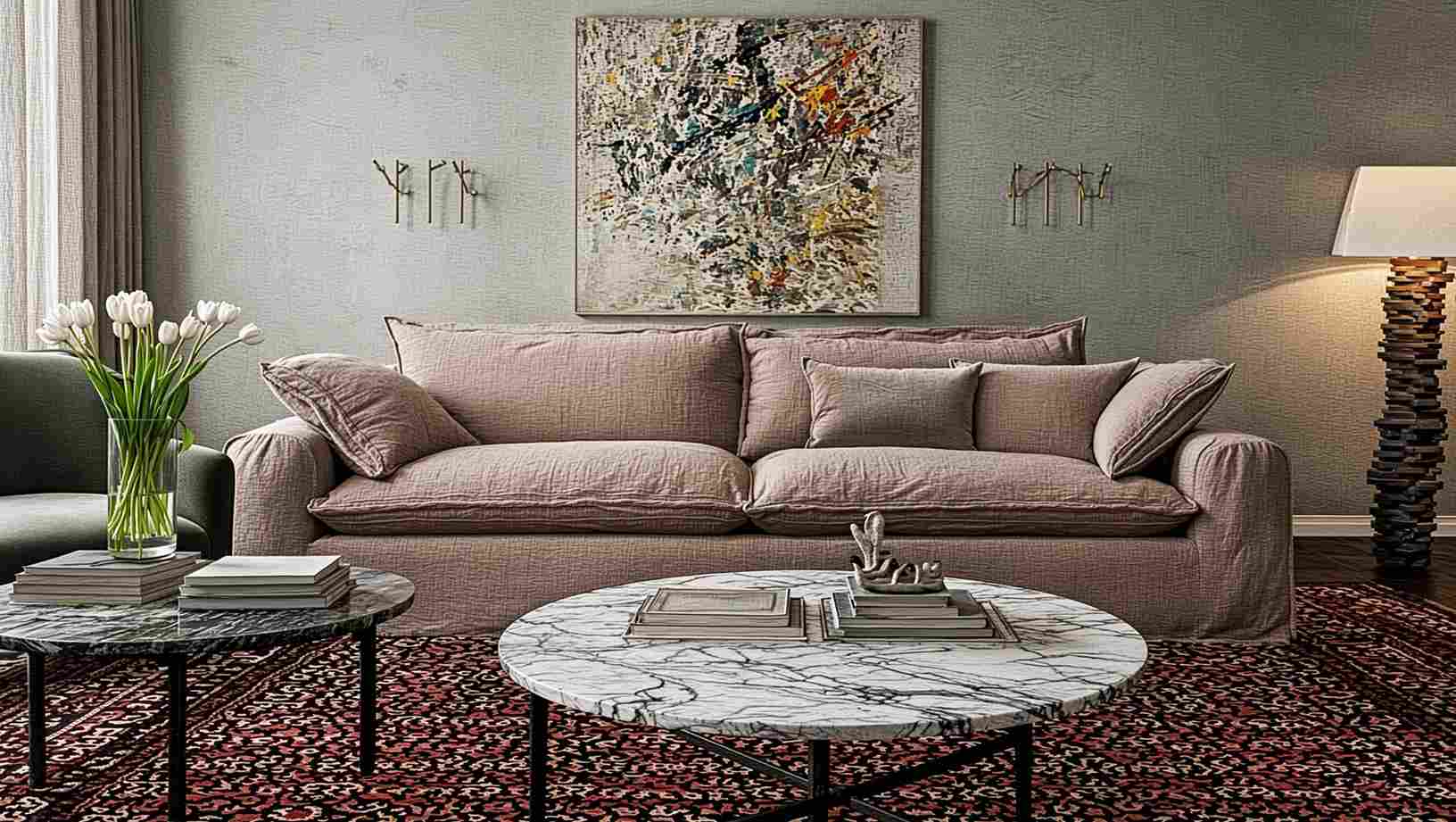
- Mid-century + Contemporary Art: Clean-lined furniture gives bold, graphic art room to breathe. A large abstract canvas over a low mid-century sideboard is practically a design cliché at this point—but it’s a cliché because it works.
- Mid-century + Maximalist Pattern: This is the more daring combination. A richly patterned wallpaper or a dramatically printed rug can look extraordinary against the restraint of mid-century furniture, but it requires a confident hand to pull off. The key is usually to keep the furniture itself in tonal neutrals so the pattern does all the talking.
Common Mistakes in Eclectic Interior Design (And How to Avoid Them)
Even with the best intentions, eclectic spaces can go wrong. Here are the most common pitfalls.
Confusing variety with personality. Buying lots of different things doesn’t automatically create a personal space. Personality comes from pieces that actually mean something to you, not just pieces that are visually different from each other. Edit ruthlessly in favor of things you genuinely love.
Neglecting negative space. Eclectic rooms are full, by nature—but fullness and clutter are different things. Clutter is fullness without breathing room. Every cluster of objects needs some clear space around it; every surface needs at least one empty area that lets the eye rest.
Mixing without a through-line. If your room has no color that repeats, no material that echoes, no scale that anchors, it will feel incoherent regardless of how beautiful the individual pieces are. Identify your through-line before you start buying, and commit to it.
Letting one dominant style overwhelm. A room that’s 90% mid-century with one bohemian accent isn’t eclectic—it’s just a mid-century room with an accent piece. Genuine modern eclectic interior design style requires real mixing: at minimum, two or three distinct visual influences that carry roughly equal weight.
Color Palettes That Work Beautifully in Eclectic Spaces
Color is where eclectic rooms can either soar or stumble. Here are a few palette directions that consistently work well in modern eclectic interior design.
Warm Neutrals + Jewel Accents: A base of warm cream, sand, and tan, punctuated by deep teal, plum, or forest green. This combination is rich without being overwhelming and works across almost any mix of styles and periods.
Earthy Tones + Unexpected Brights: Terracotta, rust, olive, and warm brown form the base; a single strong accent—cobalt blue, acid yellow, bright coral—adds surprise. The earthy tones keep the bright from reading as garish.
Soft, Chalky Pastels + Raw Naturals: Dusty rose, sage, lavender, and muted powder blue alongside natural wood, linen, and raw stone. This palette creates a soft, slightly vintage feeling that works particularly well in bedrooms and living rooms.
Monochromatic with Texture Variation: Staying within a single color family but varying the materials dramatically—matte, glossy, rough, smooth—creates a sophisticated, controlled version of eclectic design that feels deliberately curated.
FAQ
Frequently Asked Questions About Modern Eclectic Interior Design
What exactly is modern eclectic interior design?
Modern eclectic interior design is the practice of combining elements from multiple design periods, styles, and cultural influences into a single, cohesive space. The “modern” component grounds the approach in contemporary sensibility, ensuring the result feels current rather than nostalgic. The key distinction from simply mixing things randomly is intentionality: in eclectic design, every combination serves a visual or emotional purpose.
How is eclectic design different from maximalism?
While there is overlap, they’re not the same thing. Maximalism is specifically about abundance—more pattern, more color, more objects, more layers. Eclectic design is about variety of influences rather than necessarily quantity of objects. An eclectic room can be relatively spare; a maximalist room might actually stick to a single style. The Venn diagram overlaps considerably in practice, but the underlying philosophies are different.
Is eclectic mid century modern interior design a specific style?
It’s more of a popular framework than a distinct named style. Many designers use mid-century modern pieces as an anchor because the clean lines and honest materials work well with almost any other influence. The term describes a specific approach to building eclectic rooms—starting with mid-century bones and layering other influences on top—rather than a codified aesthetic with specific rules.
How do I keep an eclectic room from looking cluttered?
The most reliable technique is to establish clear negative space: every grouping of objects needs some visual breathing room around it. Edit regularly—if something doesn’t contribute to the room’s color story, texture variety, or personal narrative, it probably doesn’t need to be there. Also, anchoring the room with a few large-scale pieces prevents it from feeling like a collection of small things competing for attention.
Can eclectic design work in small spaces?
Absolutely. In fact, small spaces often benefit from eclectic layering because it creates the impression of depth and richness that might otherwise feel absent. The adjustments you need to make are mainly about scale—choosing smaller statement pieces, using vertical space more intentionally, and being more selective about what you include—but the principles remain exactly the same.
How many design styles can I mix in one room?
There’s no hard rule, but three to four distinct influences tends to be the sweet spot. Fewer than that and the room might not read as truly eclectic; more than that and it becomes genuinely difficult to maintain coherence. The more influences you introduce, the more discipline you need to apply in keeping the color story and proportions consistent.
What’s the easiest way to start with modern eclectic interior design style?
Start with a single piece you love—something personal and meaningful—and build from there. Don’t try to design the whole room at once. Layer incrementally, stepping back to assess after each addition. Buy things you love even when you’re not sure yet where they’ll go. Eclectic rooms have a way of finding their own logic when they’re built slowly and honestly.
Is eclectic interior design expensive?
Not inherently. In fact, the willingness to mix high and low is one of eclectic design’s defining characteristics. Thrift stores, vintage markets, estate sales, and independent artisans are all excellent sources for eclectic pieces, often at far lower prices than retail furniture. Investment pieces can be balanced with very affordable finds without anyone being able to tell the difference.
How do I know if my eclectic room is working?
Trust your instincts more than any rule. A working eclectic room feels comfortable to be in, makes you want to stay, and reveals new details the longer you look at it. If the room feels restless or unsettled—if your eye keeps being pulled somewhere uncomfortable—something in the balance is off. Often it’s either the proportions or the color story that needs adjusting.
What’s the role of art in eclectic interior design?
Art is often the most powerful cohesive element in an eclectic room. A piece of art that contains most of your room’s colors acts as a visual proof that those colors belong together. Art also brings a narrative layer that furniture alone can’t provide: it signals something about the inhabitant’s interests, sensibility, and history in a way that objects generally don’t. In modern eclectic interior design, art isn’t decoration—it’s often the room’s emotional center.
Conclusion
Designing a Home That Looks Like You
There’s a reason modern eclectic interior design has outlasted every trend cycle: it isn’t a trend. It’s a philosophy—one that says a home should reflect the full complexity of the person living in it, not just one curated slice of a design magazine.
The most beautiful eclectic rooms are the ones that feel genuinely inhabited. They hold their owner’s travels and inheritances and impulse purchases and considered investments all in the same space, and somehow—through color and proportion and texture and a very good eye—it all makes sense.
That’s what this style asks of you: not a big budget, not access to rare antiques, not even a trained eye. Just honesty. Bring in the things that genuinely move you, learn the handful of principles that create visual coherence, and then trust the process. The room will tell you what it needs.
Modern eclectic interior design style is ultimately less about the furniture and more about the freedom to design a home that couldn’t belong to anyone but you. That freedom—hard-won through real choices and real editing—is what makes these spaces so compelling to live in, and so endlessly worth the effort.


